
Wero is bad for consumers and bad for the economy
Wero promises to modernize European payments, yet merely digitizes the same pseudo-competitive structure that has long let banks charge punitive overdraft rates while stifling genuine innovation.

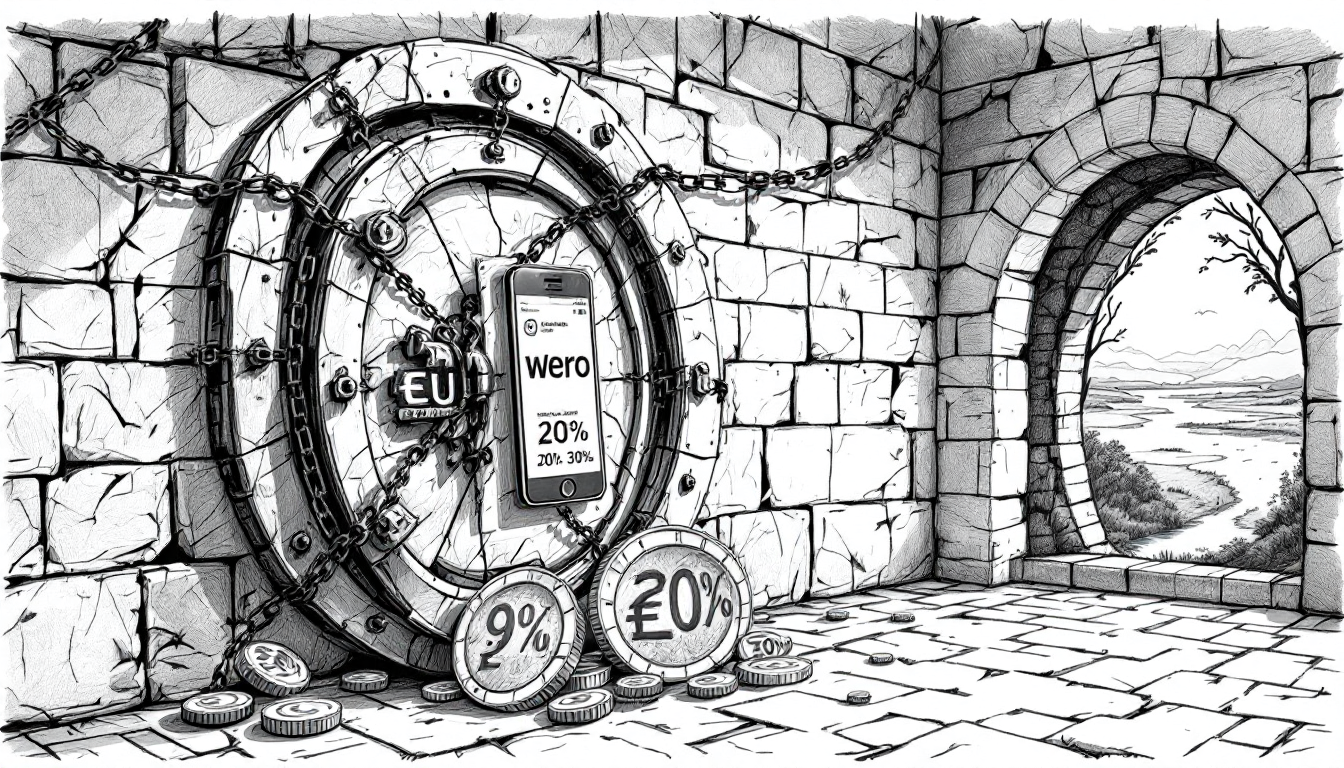
Since July 2024, a consortium of 14 European banks from Belgium, France, Germany, and the Netherlands, alongside payment services companies Nexi and Worldline, has been rolling out Wero, a new smartphone application for peer-to-peer transfers and merchant payments[1]. The initiative promises to "change the way Europe pays" by addressing supposed inefficiencies of "long IBANs, transfer delays and confusing rules"[2]. This pitch rings hollow upon examination.
The problems Wero claims to solve are largely imaginary. Credit cards resolved the issues of cumbersome bank numbers and payment delays decades ago. Modern card payments work instantly, both online and in shops, without requiring anyone to memorize or manually enter lengthy account numbers. In-store transactions require merely presenting a card; online purchases leverage browser autofill or simple copy-paste functions. Contemporary credit cards offer smartphone-based authentication, and many providers enable single-use virtual cards for enhanced security and privacy. For person-to-person transfers, established solutions like PayPal have operated successfully for years.
The real inefficiency lies in European banks' pseudo-competitive practices. Across the European Union, banks routinely impose overdraft interest rates that dwarf central bank rates—typically starting at 9-11% and sometimes exceeding 30%, while rarely dropping below 6% even for preferred customers. These same institutions offer negligible interest on current accounts, forcing customers to open separate savings accounts that yield returns an order of magnitude lower than overdraft charges. Most remarkably, consumers cannot obtain a basic current account without accepting these overdraft terms, creating a captive market where banks segment customers by tier rather than competing on rates and fees.
This structure creates tangible economic harm. Consider a consumer in a furniture store contemplating a purchase of several thousand euros. Using a debit card or Wero requires either maintaining sufficient funds in a low-yield current account or immediately incurring exorbitant overdraft charges. Transferring money from savings often takes a full business day. By contrast, an American-style credit card allows the purchase immediately, with up to a month to consolidate funds from various accounts interest-free. This flexibility benefits both consumers, who avoid unnecessary interest charges, and merchants, who close more sales. While businesses pay higher fees to credit card companies than to Wero, the increased conversion rates justify the expense.
The fundamental distinction between these models reveals European banks' true motivation. The consumer-friendly credit card ecosystem remains dominated by American financial institutions. Rather than competing through innovation, lower fees, or technological efficiency, European banks seek to preserve their rigid, high-margin business model under the guise of "European independence." What they present as sovereignty is merely protectionism for uncompetitive practices.
Wero represents not progress but entrenchment—a digital veneer on an antiquated system that continues to extract excessive rents from both consumers and businesses. Until European banks address their fundamental pseudo-competitive behaviors, no amount of technological window-dressing will deliver the efficiency gains that European payments genuinely need.
Wero: Der europäische Bezahldienst unter der Lupe (heise.de, accessed 2025-08-13) ↩︎
About Wero (Wero official website) ↩︎